Earlier this week I was buying cupcakes for a client. I already knew where I was going to buy them. I’d used the company before, trusted the product and landed on the website ready to purchase.
From a marketing perspective, I was the ideal customer.
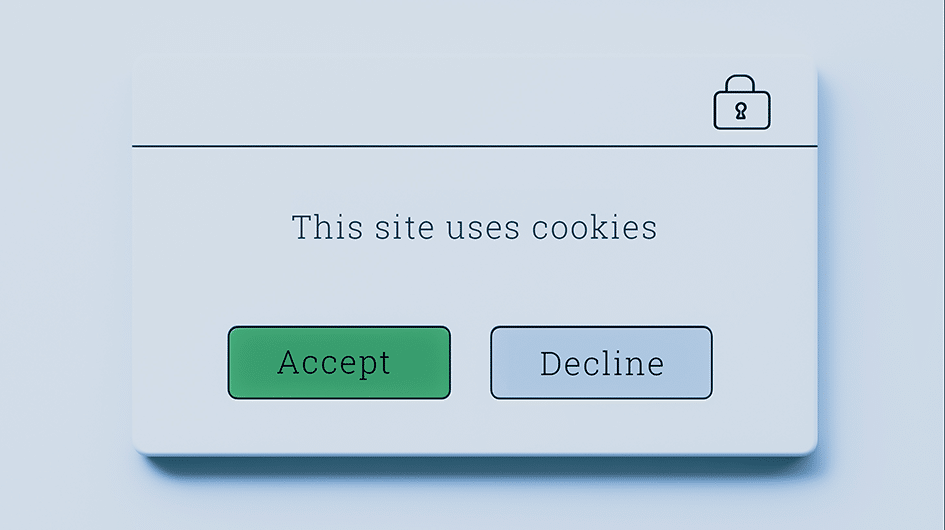
But before I could even read the homepage, four different prompts appeared simultaneously:
- Cookie consent
- Live chat
- Newsletter sign-up
- A 10% discount offer
Individually, every one of those tools makes perfect sense.
Cookie banners are a legal necessity. Live chat helps answer questions. Email capture builds valuable first-party data. Promotional offers can increase conversion rates.
The problem wasn’t the tools.
It was the timing.
When optimisation starts working against itself
Very few businesses deliberately create poor digital experiences.
Instead, they evolve over time.
Marketing introduces a newsletter pop-up. Customer service adds live chat. E-commerce launches a promotional overlay. Compliance implements cookie consent.
Each decision is sensible.
Each team is solving a genuine problem.
Each platform proudly reports improved performance against its own KPI.
The chat platform celebrates more conversations.
The email platform celebrates more subscribers.
The promotion platform celebrates more discount redemptions.
Every dashboard looks healthy.
What none of them report is the customer who arrived with the intention to buy, became overwhelmed by competing messages and simply left.
That lost visitor rarely appears in anyone’s reporting.
Experience is bigger than individual metrics
Modern websites are often packed with tools designed to improve performance.
But optimisation only works when every element works together.
A website shouldn’t feel like multiple technologies competing for attention.
It should feel like one coherent experience.
That’s why it’s worth asking a few simple questions:
- What does a visitor actually see in the first ten seconds?
- Are multiple prompts competing for the same moment?
- Are messages triggered by behaviour rather than immediately on page load?
- Are existing customers seeing the same acquisition messages as new visitors?
- When someone dismisses a prompt, does it actually stay dismissed?
These aren’t technical questions.
They’re customer experience questions.
The biggest opportunity is often invisible
In the end, I bought the cupcakes.
Not because the experience was good, but because I already trusted the brand and knew exactly what I wanted.
Most visitors won’t be that patient.
They’ll simply leave.
No complaint.
No feedback.
Just another anonymous bounce hidden inside your analytics.
Sometimes improving website performance isn’t about adding another tool.
It’s about knowing when not to interrupt.
Call to action
Wonder what your website looks like through the eyes of a first-time visitor?
At Mobas, we help organisations uncover the hidden friction that affects conversion, engagement and customer experience. Sometimes the biggest improvements don’t come from adding more technology, but from making the technology you already have work together.
If you’d like an honest review of what happens during the first ten seconds on your website, we’d be delighted to take a look.